
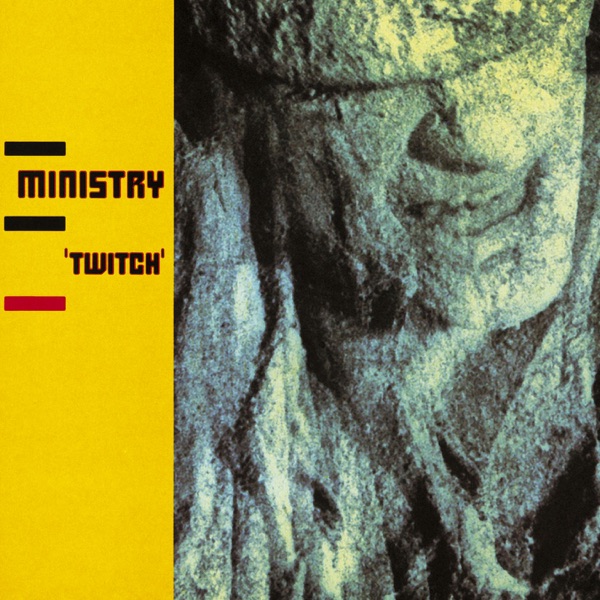
Why it's in the canon
Twitch is where Ministry first used sampling, and where Al Jourgensen swapped the synth-pop of With Sympathy for a darker, more aggressive sound heavily influenced by the industrial dance groups Cabaret Voltaire and Front 242. Sampling became one of the band's trademarks. The single Over the Shoulder, with its layered looped synthesizer parts over a heavy drum-machine pattern, is cited as an early example of electro-industrial.
AllMusic's Alan Escher wrote that the record sounds nothing like Ministry's other albums, and that listeners may hear in it how the band became what it did.
Twitch, released by Sire on 12 March 1986, is more abrasive and beat-driven than anything Ministry had made before. It is primarily an EBM album, with aggressive industrial tracks such as We Believe, which has been described as a sequencer hammerlock, and Where You at Now?/Crash And Burn/Twitch, set against brighter synth-pop in Over the Shoulder, All Day Remix and The Angel. Jourgensen still sings in the English accent of the debut, but now through distortion effects, over white noise and distortion in the production. The opening Just Like You is, by his account, his first real political Ministry song.
Adrian Sherwood, the owner of On-U Sound Records, produced most of it after Seymour Stein hired him on the strength of his remixes of Depeche Mode's People Are People and Master and Servant. The sessions ran in Chicago, at Southern Studios in London and at Hansa Tonstudio in West Berlin, and Jourgensen co-produced two tracks. Keith LeBlanc supplied percussion and programming on one, and Luc van Acker sang on another. Jourgensen later said he could not feel the record was really his because it was so Sherwood-influenced.
Reviews were mixed. Robert Christgau called it fleetingly gothic, marginally industrial and unrelenting in a vaguely threatening way, with a band shouting that the world is ending on a crowded dancefloor. Ira Robbins of Trouser Press found much of it dull but singled out the militaristic All Day Remix as a sign of Jourgensen's direction. The album entered the Billboard 200 on 4 April and peaked at number 194; the American sales had reached 138,755 by February 2007. The tour that followed was the first with Paul Barker on bass and Bill Rieflin on drums.
Basic Information
- Released
- 1986-03-12
- Canon Tier
- Landmark


