Why it's in the canon
Free Jazz: A Collective Improvisation gave a genre its name: a continuous 37-minute improvisation by two quartets playing at once, one in each stereo channel, recorded in one take with no overdubbing or editing and only a few brief composed passages. The genre takes its name from the album, which was the first album-length improvisation, unheard of at the time. AllMusic's Steve Huey called it a staggering achievement that practically defies superlatives in its historical importance, and it served as the blueprint for later large-ensemble free jazz recordings such as John Coltrane's Ascension and Peter Brötzmann's Machine Gun. Down Beat split on it, with Pete Welding giving it five stars and John A. Tynan none.
Free Jazz: A Collective Improvisation is built as two quartets heard in separate channels. Coleman's working quartet plays on the left, with Don Cherry on pocket cornet, Scott LaFaro on bass and Billy Higgins on drums. On the right is a second quartet of Eric Dolphy on bass clarinet, Freddie Hubbard on trumpet, Charlie Haden on bass and Ed Blackwell on drums. Both groups play at the same time. The two rhythm sections lay a dense foundation over which the wind players either solo or comment freely, and the composed material, a series of brief dissonant fanfares for the horns, serves as interludes between the solos.
The album's timing sheet gives the order. The first solo is Dolphy's bass clarinet at 0:22, followed by Hubbard's trumpet at 5:40 and Coleman's alto saxophone at 10:05. Cherry takes over at 19:48. Haden's bass solo starts at 25:26 and LaFaro's at 30:00, and the drummers close the piece, Blackwell at 34:00 and Higgins at 35:28.
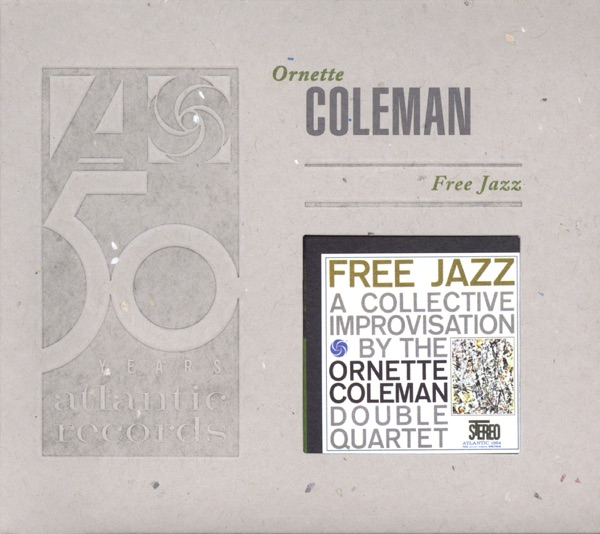
It was recorded on 21 December 1960 at A&R Studios in New York, with Tom Dowd as recording engineer and Nesuhi Ertegün as producer, and released by Atlantic in September 1961. The gatefold sleeve carried Jackson Pollock's 1954 painting The White Light, glimpsed through a cutout window, with liner notes by Martin Williams. Coleman was a fan of Pollock and a painter himself.
The 1998 CD reissue in Rhino's Atlantic 50 series ran the title track as one continuous piece, which the original LP had split across its two sides, and added the session's only outtake, First Take.
Basic Information
- Released
- 1961
- Canon Tier
- Pinnacle
' /%3E%3C/svg%3E)