Why it's in the canon
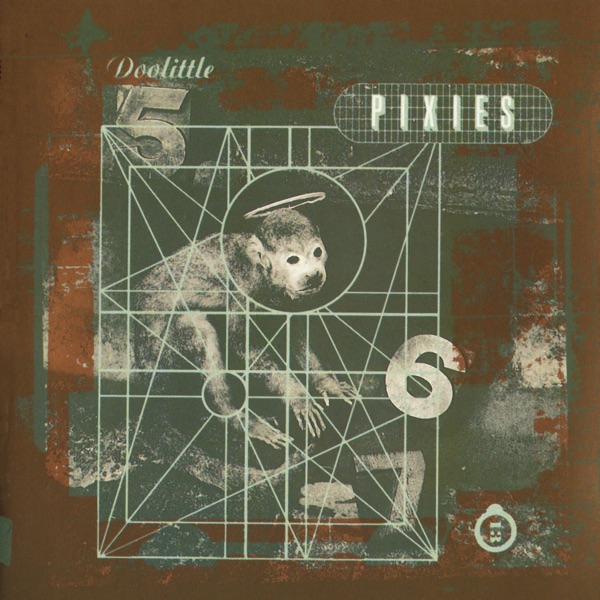
Doolittle set out the quiet/loud dynamic that alternative rock took up in the early 1990s: subdued verses carried by Kim Deal's bass and David Lovering's drums, then peaks of distorted guitar from Black Francis and Joey Santiago. Kurt Cobain said its songs heavily influenced Smells Like Teen Spirit, which he described as his attempt at writing a Pixies song, and after writing it Cobain and Krist Novoselic thought it sounded like the Pixies. Slowdive have noted the album as a significant influence on their sound, and a 2002 Rolling Stone review said it laid the groundwork for Nineties rock.
Doolittle is built from short songs: only three of its 15 tracks run longer than three minutes. It opens with Debaser, a noisy surf-punk song that starts on Kim Deal's bass pattern, breaks into the chorus when Joey Santiago's riff and Black Francis's shouted vocal arrive, and ends in an extended coda of frenzied guitar. Tame sits on a three-note bass line of D, C and F under Santiago's E7♯9 chord, which he called his Hendrix chord, and in the chorus Francis screams the title word. Gouge Away closes the record on Deal's three-note bass and a tight drum pattern that Sisario described as a kind of gothic dance groove.
Monkey Gone to Heaven adds cellos, violins and plucked piano strings, which made the producer Gil Norton nervous because they took the band outside its usual parameters. Its lyrics describe human-caused destruction of the ocean and use numerology to make the Devil six and God seven. David Lovering sings La La Love You in a baritone meant as satire of 1950s crooning.
Norton recorded it at Downtown Recorders in Boston from 31 October 1988, on a $40,000 budget four times that of Surfer Rosa. In the mix he smoothed the band's rough edges with tight compression and added reverb and delay to guitars tracked in layers. He had advised Francis to slow There Goes My Gun, once a faster Hüsker Dü-style song, and Santiago, unhappy with the reverb on his guitar, covered his Marshall amplifiers with blankets in protest.
It came out on 17 April 1989, reached number eight in the UK, and entered the Billboard 200 at 171 before rising to 98 with college-radio play of Monkey Gone to Heaven. NME's Edwin Pouncey wrote that the songs have the power to make you literally jump out of your skin with excitement. Melody Maker and Sounds named it album of the year.
Basic Information
- Released
- 1989-04-17
- Canon Tier
- Pinnacle
' /%3E%3C/svg%3E)