Why it's in the canon
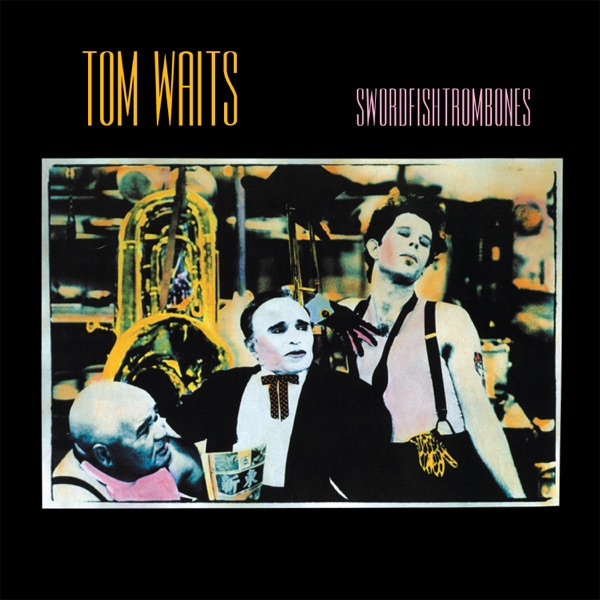
Swordfishtrombones is where Tom Waits left the piano-based songwriting of his first seven albums for banjo, bass marimba, metal aunglongs and a calliope, and widened his subject from a neighbourhood to a world of misfits. David Smay called it the record where Waits radically reinvented himself and reshaped the musical landscape, and The Guardian heard in the trilogy it began a bid to take in the whole history of American song. Spin ranked it the second greatest album of all time in 1989, and Elvis Costello put it on his list of essential albums. Ian Rankin recalls hearing it with a friend, both transfixed, as if a vaudeville show was taking place in a scrapyard.
Swordfishtrombones has fifteen tracks and no saxophone. Waits described the instrumentation in a contemporary interview as banjo, accordion, bass-marimba, metal aunglongs, African squeeze drum, a calliope and a harmonium. The credits bear him out: Victor Feldman is listed on Dabuki drum and African talking drum, Francis Thumm on metal aunglongs and glass harmonica, Anthony Clark Stewart on bagpipes, and Waits himself on harmonium, a freedom bell and, on one track, a chair.
AllMusic heard the words change as well: tales of the drunken and the lovelorn gave way to surreal accounts of people who burned down their homes and of Australian towns bypassed by the railroad. The same review found the music at times primitive and moving to odd time signatures, with Waits alternately howling and wheezing in his gravelly bass voice, and placed him closer to Kurt Weill and Howlin' Wolf, as impersonated by Captain Beefheart, than to Hoagy Carmichael and Louis Armstrong.
Waits wrote the songs during a two-week trip to Ireland and produced the record himself at Sunset Sound, the first of his albums produced without help. He had just finished the One from the Heart soundtrack and parted with both his producer Bones Howe and his manager Herb Cohen, and his wife Kathleen Brennan had introduced him to Captain Beefheart and Harry Partch. Asylum declined to release the finished album, and Chris Blackwell of Island Records offered to put it out. Waits did not tour for it.
Billboard called it his most varied, eclectic album yet and thought its 15 tracks might be a hard sell at radio, while Cashbox judged it his best and most accessible album since Small Change. It peaked at number 167 on the Billboard 200. NME ranked it the second best album of 1983, and Pitchfork put it 11th in its 2002 list of the best albums of the 1980s.
Basic Information
- Released
- 1983-09-01
- Canon Tier
- Pinnacle


' /%3E%3C/svg%3E)