Why it's in the canon
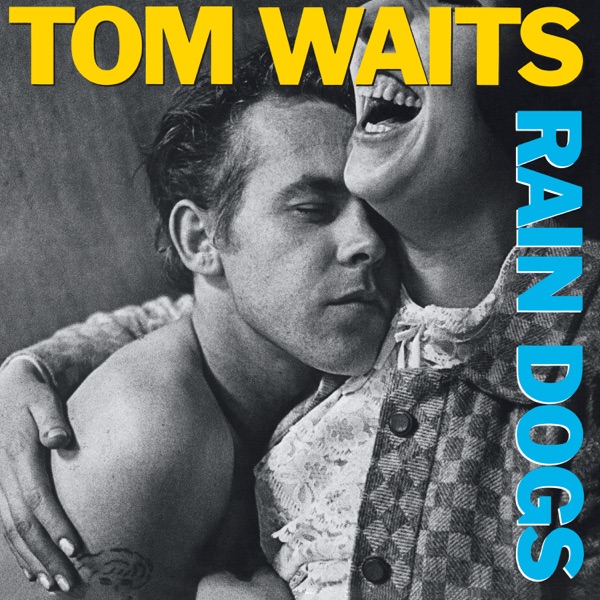
Rain Dogs fused Kurt Weill's cabaret, pre-rock dirty blues and the elegiac brass of New Orleans funerals into what Rolling Stone's Arion Berger called a singularly idiosyncratic American style, bony and menacingly beautiful. Radiohead's Thom Yorke has said that he fell asleep to it on his Walkman, that every track was a short movie, and that he has played it over and over throughout his life. When the actor Robert Carlyle formed a theatre company, he named it the Rain Dog Theatre after the album. Pitchfork ranked it 8th among the albums of the 1980s, and Elvis Costello put it on his list of essential albums.
Rain Dogs, released by Island in September 1985, is a loose concept album about the urban dispossessed of New York City, a theme Barney Hoskyns traces in part to Martin Bell's 1984 documentary Streetwise, to which Waits had contributed music. Waits wrote most of it in a basement room in Lower Manhattan in the fall of 1984 and carried a cassette recorder around the streets to collect ambient noise. The band plays marimba, accordion, double bass, trombone and banjo, and the sound stays organic: Waits said that when the drum kit would not give the right sound, they banged a chest of drawers in the bathroom with a two-by-four. He called the result kind of an interaction between Appalachia and Nigeria.
Marc Ribot, in his first major-label session, recalled that the band never rehearsed; Waits played each song on a ratty old hollow-body in the studio and spelled out the grooves. Keith Richards plays on Big Black Mariah, Union Square and Blind Love. Berger heard a desultory electric-guitar solo as cold as the rattle of marimbas in Clap Hands, and the novelist Ian Rankin called the opening Singapore a novel contained within two and a half minutes of controlled musical mayhem. Rod Stewart's cover of Downtown Train reached the top five in 1990.
Robert Palmer of The New York Times hailed it as the year's best and most dazzling and protean pop album, and NME ranked it jointly first for 1985 with the Jesus and Mary Chain's Psychocandy. Anthony DeCurtis was mixed in Rolling Stone, finding that it insists on nosing its way around barrooms and back alleys Waits had often visited, and AllMusic's William Ruhlmann wrote that it could not surprise as Swordfishtrombones had, although there was enough of it to qualify as one of Waits's better albums. Rolling Stone ranked it 21st among the 1980s albums in 1989.
Basic Information
- Released
- 1985-09-30
- Canon Tier
- Landmark


' /%3E%3C/svg%3E)