
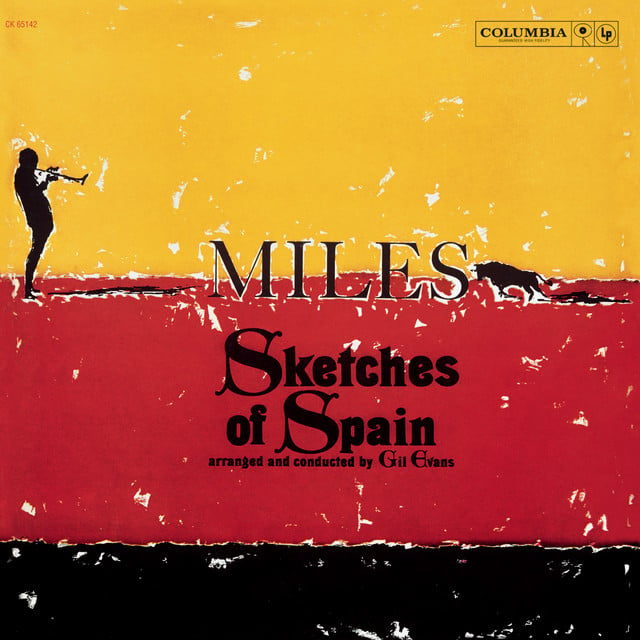
Why it's in the canon
Davis and the arranger Gil Evans took the adagio of Joaquín Rodrigo's Concierto de Aranjuez, a guitar concerto from 1939, and gave it almost half of a record, with Davis carrying the guitar melody on flugelhorn into an orchestral setting in which most of the piece has hardly any jazz rhythm. The album belongs to third stream, the fusion of jazz, European classical music and styles from world music. In DownBeat, Bill Mathieu wrote that if there is to be a new jazz, a shape of things to come, then this is the beginning; Q said it took orchestral jazz in a new direction. Evans and Davis won the 1961 Grammy for Best Jazz Composition of More Than Five Minutes Duration.
Sketches of Spain opens with a long arrangement of the adagio from Rodrigo's Concierto de Aranjuez. Davis states the guitar melody faithfully on flugelhorn, then Evans's orchestration moves into what his biographer called a quasi-symphonic, quasi-jazz world of sound. The middle holds a chorus by Evans that has nothing to do with the concerto but is echoed in the other pieces, and the original melody returns in a darker mode. At rehearsal Davis said he had to make things connect, make them mean something in what he played around it, and he thought the adagio so strong that the softer he played it, the stronger it got.
The plan had been the Concierto alone. Evans copied the music off the only record available, because there was no score, and as he listened to other folk music, including music played in clubs in Spain, it turned into a Spanish album. The folk pieces were inspired by Alan Lomax's recordings in Galicia and Andalusia, issued by Columbia Masterworks in 1955. The Pan Piper takes its name from the pan flute and the melody a pig's castrator and knife grinder played on arriving in Galician villages, Saeta is a religious song sung in Holy Week processions, and Solea is a form of flamenco. Sessions ran from November 1959 to March 1960 at Columbia's 30th Street Studio, and Teo Macero produced a Davis album for the first time.
Reception divided. Martin Williams found the recording something of a curiosity and a failure. Davis had not sought the composer's permission, and Rodrigo's wife, Victoria Kamhi, described the recording in her memoir as an act of piracy. Robert Christgau recalled it as the record that began his disillusionment with jazz. J. D. Considine called it a work of unparalleled grace and lyricism, and Rolling Stone ranked it 358th among the 500 greatest albums.
Basic Information
- Released
- 1960-07-18
- Canon Tier
- Pinnacle


