Why it's in the canon
Twelve tracks cut by a nonet in 1949 and 1950 gave jazz a chamber sound: horns blended like a choir, where the big bands had set sections against each other in thrust and parry, at slow tempos and with a lyrical approach to improvisation. Davis said he wanted the instruments to sound like human voices singing. Down Beat wrote in 1957 that the collection had influenced one important direction of modern chamber jazz deeply. The nonet's members took the sound into cool jazz: Gerry Mulligan formed a piano-less quartet with Chet Baker, and John Lewis became music director of the Modern Jazz Quartet. Capitol was disappointed with the sales of the recordings and did not offer Davis a contract extension.
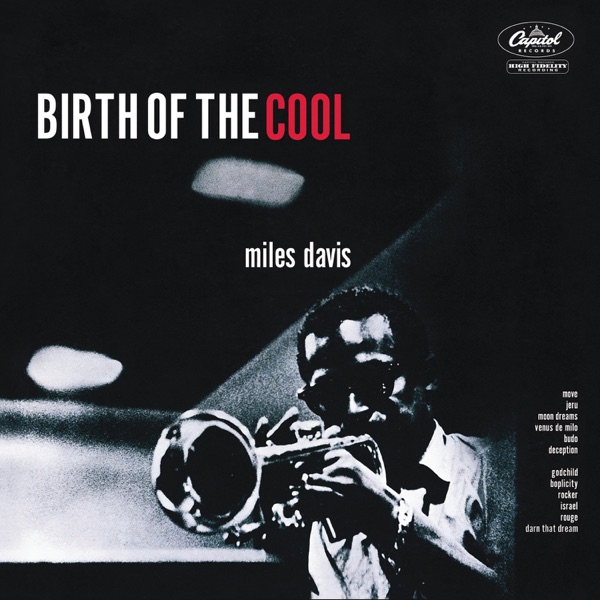
Birth of the Cool is a compilation released by Capitol in 1957 of twelve tracks that Miles Davis's nonet recorded in three sessions between January 1949 and March 1950. The 1957 LP carried eleven of them; the only vocal, on Darn That Dream, joined the set in 1972. Most tracks first came out on 78-rpm singles, and each runs about three minutes.
The sound comes from the line-up and the writing. Trumpet and alto saxophone sit with baritone saxophone, tuba, trombone and French horn, and the arrangements work in pairs. In Move, John Lewis gives the melody to trumpet and alto, baritone and tuba supply counterpoint, and trombone and French horn provide the harmonies. Gerry Mulligan's Jeru shows the unison sound and rich harmony throughout the horns. Budo is one of the tunes considered close to bebop, with the band bookending solos by Davis, Mulligan, Lee Konitz and Kai Winding as in a bebop head arrangement.
The model was Claude Thornhill's orchestra. It gave the nonet an impressionistic style, tuba and French horn, and non-vibrato playing, and Konitz, Mulligan and Gil Evans all came out of it. Evans said the instrumentation was the smallest number of instruments that could get the sound and still express all the harmonies the Thornhill band used.
Reaction at the Royal Roost in 1948 was positive but reserved. Count Basie, the headliner, said the slow things sounded strange and good. Winthrop Sargeant of The New Yorker thought the music sounded more like a new Maurice Ravel than like jazz, and still found it charming and exciting. Carisi's Israel has become a jazz standard.
Basic Information
- Released
- 1957
- Canon Tier
- Landmark


' /%3E%3C/svg%3E)